
Elder Abuse
Elder Abuse Prevention
The NWT Seniors’ Society delivers a Train the Trainer, Elder Abuse Workshop annually. The purpose of the workshop is to support Indigenous Governments, community governments, and community organizations to deliver culturally safe and appropriate elder abuse workshops in their communities.
For more information, contact the Executive Director at 867-920-7444 or by email at ed@seniorsnwt.ca.
Violence against seniors and their perceptions of safety in Canada
- Seniors are the fastest growing population in Canada. In 2020, Canada was home to 6.8 million persons aged 65 years and older, comprising 18% of the total population (Statistics Canada 2021).
- Statistics Canada predicts that, by 2030, more than one in five Canadians will be seniors, a figure that increases to one in four by 2060 (Statistics Canada 2019b). By 2030, one in five people will be over the age of 65.
- According to the General Social Survey on Canadians’ Safety (Victimization), there were about 128,000 senior victims of violence in Canada in 2019.
- Overall, three-quarters (76%) of seniors who reported experiencing violent victimization in 2019 were physically assaulted.
- According to the Uniform Crime Reporting Survey, the rate of police-reported violence against seniors increased 22% between 2010 and 2020, with the largest increase observed in the past five years among senior men.
- Senior women who experienced police-reported violence were twice as likely to have been victimized by an intimate partner compared with senior men (16% versus 7%)
- More than half (60%) of all police-reported violence against seniors involved the use of physical force and an additional 19% involved the presence of a weapon.
- About one-third (35%) of seniors suffered a physical injury because of the violence they experienced.
- In 2020, the rate of police-reported violence against seniors was highest in the territories and New Brunswick.
- Between 2015 and 2020, police-reported senior victimization increased in every province and territory
- Although prevalence estimates vary, violence against seniors is thought to affect approximately one in eight older adults living in the Americas (Yon et al. 2017).
- The risk of experiencing various forms of abuse is heightened among certain segments of the senior population. Specifically, those who are socially isolated, cognitively impaired, physically frail, living in institutionalized settings or dependent upon others for care are at an increased risk of experiencing abuse (Brijnath et al. 2021; Pillemer et al. 2016).
- The consequences of abuse, which in turn intensify the risk of recurrence, include an increased likelihood of developing mental or physical health conditions, hospitalization, cognitive decline, nursing home placement and mortality (World Health Organization 2021; Yunus et al. 2019).
Programming for Elder Abuse
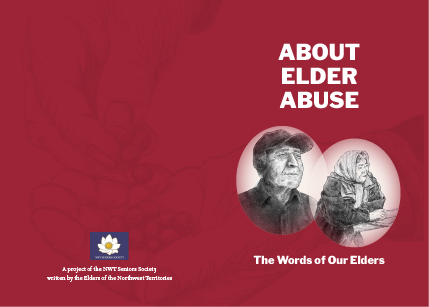
About Elder Abuse, The Words of Our Elders
The NWT Seniors’ Society with funding from the De Beers Group and New Horizons for Seniors, Government of Canada facilitated three workshops with Elders across the NWT to redefine the terms associated with Elder abuse and to write their scenarios.
This booklet represents their definitions, examples and stories. You can download a copy of the booklet below.
Additional Resources
Future Us: A Roadmap to Elder Abuse Prevention
Future Us: A Roadmap to Elder Abuse Prevention
Working Together With Elders
Working Together With Elders
Canadian Network for the Prevention of Elder Abuse
Canadian Network for the Prevention of Elder Abuse – CNPEA
It’s Not Right! Neighbours, Friends and Families for Older Adults
It’s Not Right | Neighbours, Friends and Families for Older Adults
Government of Canada Elder Abuse
Elder Abuse – Canada.ca
Government of the Northwest Territories
Protecting Elders from Abuse and Neglect | Health and Social Services